
What She Didn't Write About
On Phillis Wheatley, Juneteenth, and the Calculations We Still Make

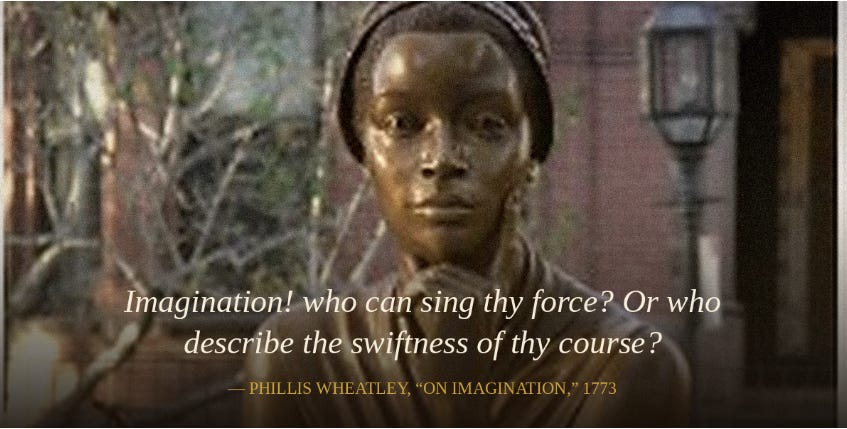
Before Phillis Wheatley could publish a single poem, she had to be examined.
Not edited. Examined.
A panel of Boston’s most white powerful men, ministers, judges, and the governor himself gathered to determine whether a teenage girl, enslaved, could possibly have written the poems attributed to her. They questioned her on classical literature, on theology, and on Latin. She passed. They signed their names to an attestation swearing that yes, this was her own work, because without their signatures, no one would believe a Black woman capable of it.
This is usually where the story stops. The trial, the proof, the eventual publication. A triumph against impossible odds.
But I want to stay a little longer in the part of the story we tend to skip past.
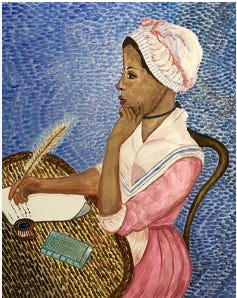
Wheatley passed that examination because she had spent years calculating exactly how much of her mind she could safely reveal. Not what she knew. How she revealed it. Which references would prove her education without threatening the men judging her. Which forms would showcase her skill without suggesting an ambition that might unsettle them.
Look at how carefully she addressed the men who held power over her readers’ opinion of her. In her poem to the Earl of Dartmouth, she wrote of freedom in the abstract, of liberty as a grand and worthy cause, before turning the lens on herself only briefly:
“Should you, my lord, while you peruse my song, / Wonder from whence my love of Freedom sprung.”
She gives him the question before he can ask it. That is not naivety. That is strategy.
And in what may be her most quoted poem, she wrote:
“Some view our sable race with scornful eye, / Their colour is a diabolic die. / Remember, Christians, Negros, black as Cain, / May be refin’d, and join th’ angelic train.”
Four lines. A direct address to the very people capable of dismissing her. Delivered gently enough to be published, sharply enough to still cut two and a half centuries later.
She did not write about slavery directly very often. When she did, it arrived wrapped in scripture, gratitude, and careful diplomacy. Some have read this as evidence she had made peace with her condition. I read it differently.
I think she was calculating.
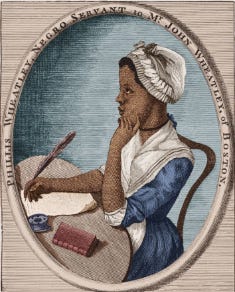
I know something about that calculation, because I have made it myself.
There is a particular kind of hesitation that comes from existing in mixed spaces, rooms where you are watching not just what you say but how it lands, recalibrating in real time, doing math that has nothing to do with the actual conversation. A comment lands wrong. You decide whether to address it or let it pass. You choose your words three times before you speak them once. This happens so often it stops registering as exhausting. It just becomes how you move through certain rooms.
I have held back intellect in spaces where I sensed it would not be welcomed, where the room had already decided how much of me it was prepared to receive. Not because I lacked the thought. Because I was calculating the cost of saying it.
And there is a narrower calculation too, the one about what we are permitted to write.
Black writers are often handed an unspoken contract. Write the trauma, and the world will read it. Write the joy, the whimsy, the interior life that has nothing to do with suffering, and watch the room get quieter. There is a story we are allowed to tell, and a story we are simply expected to tell, and the distance between those two things is where so much of our actual range goes to die.
Wheatley wrote elegies, odes, and meditations on virtue. In “On Imagination,” she wrote of a mind that could “leave the rolling universe behind” and “measure the skies, and range the realms above.” She gave herself permission to write about flight and cosmos and the unbounded soul, as if she had every right to live inside those ideas. Because she did. And history has spent two centuries treating that as the curious footnote instead of the whole point.
She was not avoiding the truth of her condition. She was claiming the right to write about anything at all.
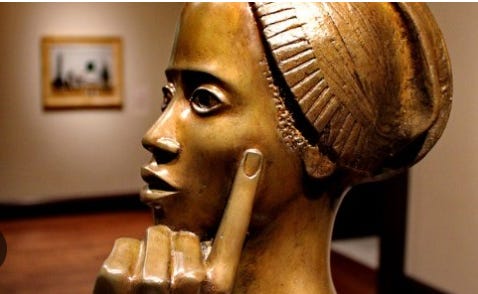
I do not think that calculation has disappeared. I think it has changed shape.
We are, in many ways, freer than Wheatley ever was. We do not need a panel of men to attest that our minds are our own. We publish without permission. We build our own rooms instead of waiting to be let into someone else’s.
But this freedom is being tested again, right now, in real time. Books are being pulled from shelves. Black authors are being challenged more than almost any other group in this country’s libraries and classrooms. The work itself, the right to put a full, complicated, unguarded interior life onto a page, is once again something somebody else believes they have the authority to examine, approve, or deny.
Juneteenth marks a freedom that arrived legally, finally, generations after it should have already existed. It is worth remembering that legal freedom and creative freedom have never moved at the same pace. Wheatley’s body was eventually freed, three years after her book was published. Her mind had to fight for room long before that, and in some ways, it is still fighting for it now.
I think about what she might have written if no one was ever watching. What I might write if I never had to calculate the room first.
I do not know the answer. But I know the question is the same one she was asking, in her own way, before any of us were here to ask it with her.
We get to write more freely now. We do not get to stop noticing when that freedom is being narrowed again.
So I want to ask you what I have been asking myself.
What have you held back saying, not because you didn’t think it, but because you were calculating the room?
Tell me in the comments. I am genuinely asking.
If you want to read her for yourself, start here:
On Imagination — the poem that shows you exactly what she was capable of when she let her mind run all the way out
On Being Brought from Africa to America — eight lines, and one of the most quietly confrontational poems of the eighteenth century
To the Right Honourable William, Earl of Dartmouth — watch how she builds her argument for freedom before she ever turns it toward herself
To His Excellency General Washington — written to the man who would become president, and answered personally by him
Poems on Various Subjects, Religious and Moral (1773) — her only published collection, and the book that had to survive a trial before it could survive the world
Thank you so much for sharing this powerful essay. I've been sitting here for 20 minutes thinking about an answer to your question and getting angrier and angrier as I do so. As a survivor of sexual assault, I've spent most of my life translating my thoughts into forms that wouldn't provoke, threaten, embarrass, or anger the men in the room. Not because I doubted myself, but because women learn early that being right and being safe are not always the same thing.
I am ashamed to say i didn't know her work, so thank you so much to bringing a new writer into my life!